
Thermoplastic elastomer (TPE) injection molding technology has gained widespread application in the manufacturing industry in recent years due to its combination of rubber-like elasticity and the easy processability of plastics.
TPE materials not only offer excellent flexibility and durability but also enable efficient and precise product manufacturing through injection molding, meeting the demands of various applications for high-performance and environmentally friendly materials.
In this article, we will explore TPE injection molding in detail, from its definition and production process to specific applications.
What Is Thermoplastic Elastomers(TPE)?
Thermoplastic Elastomer (TPE) is a class of polymer materials that combine the good elasticity of rubber with the processability of plastics.
The molecular makeup of TPE gives it a good viscosity and flow rate, making it very suitable for the injection molding process.
TPE materials exhibit outstanding flexibility, wear resistance, and chemical corrosion resistance, making them suitable for a wide range of industrial applications, such as medical devices, automotive, and consumer electronics.
The specific properties of TPEs can vary depending on the formulation and the specific application, exhibiting varying levels of flexibility, durability, and chemical resistance to meet diverse requirements.
Types Of TPE Plastics
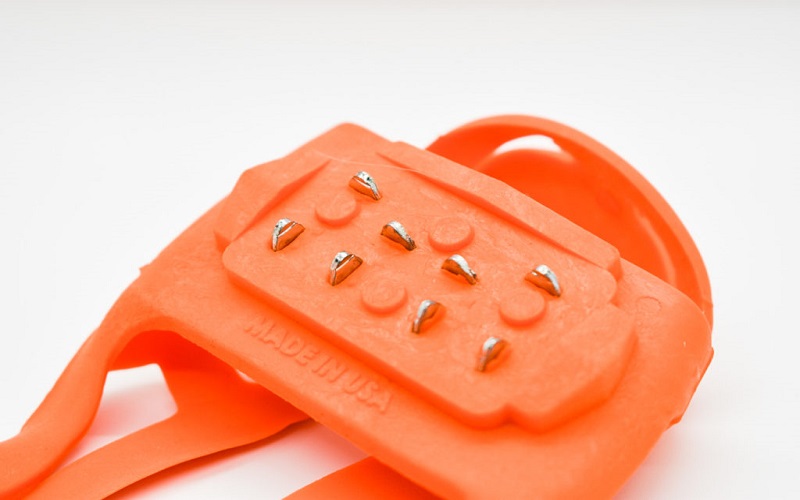
Thermoplastic elastomers (TPEs) can be categorized into six primary types based on their chemical composition and structure:
Thermoplastic Polyurethane Elastomers (TPU): TPU, or thermoplastic urethanes, is a block copolymer known for its mid-to-high hardness and good wear resistance, making them suitable for applications requiring durability and elasticity.
Thermoplastic Vulcanizates (TPV): These materials combine the properties of vulcanized rubber with the processability of thermoplastics, offering good chemical resistance and high temperature resistance, ideal for automotive and industrial uses.
Thermoplastic Olefin Elastomers (TPO): Characterized by their high impact strength, weatherability, and low compression set, TPOs are commonly used in outdoor applications and automotive parts.
Styrenic Block Copolymers (SBC): The softest and most flexible among TPEs, SBCs have a glossy surface and excellent elasticity, suitable for consumer products requiring a soft touch.
Copolyester Elastomers (COPE): Noted for their high tear strength, heat resistance, and durability, COPEs are used in demanding applications such as sports equipment and medical products.
Polyether Block Amide Elastomers (PEBA): Featuring good tensile strength, flexibility, and resistance to harsh conditions, PEBA is ideal for specialized applications requiring both strength and flexibility.
Each type of TPE material possesses unique physical and mechanical properties, allowing designers to select the right material that meets specific requirements and achieves an optimal balance between performance and cost.
TPE Type | Chemical Resistance | Temperature Resistance | Typical Applications | Unique Properties |
|---|---|---|---|---|
TPE-S | Moderate | Moderate | Soft-touch grips, consumer products | Softest and most flexible, glossy surface |
TPE-O | High | Moderate to High | Automotive parts, outdoor applications | High impact strength, weather resistant |
TPE-U | High | High | Medical devices, footwear, sports equipment | Excellent wear and abrasion resistance |
TPV | High | High | Automotive seals, industrial parts | Combines rubber elasticity with thermoplastic processability |
COPE | High | High | Sports equipment, medical products | High tear strength and heat resistance |
TPE-A | High | High | Specialized applications requiring strength and flexibility | Excellent mechanical properties and durability |
TPE Injection Molding Process
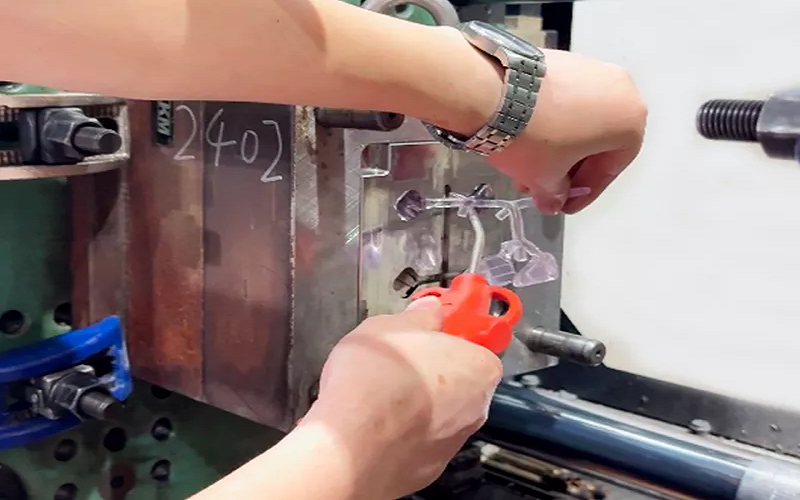
Injection molding with thermoplastic elastomers (TPEs) is a manufacturing process in which TPE material is heated until molten and then injected into a mold cavity to shape it into a desired form.
The TPE injection molding process involves several precise steps to ensure high-quality and consistent parts:
Melting: The TPE material is heated to a temperature above its melting point, transforming it into a fluid state that can flow easily and fill the mold cavity completely.
Injection: The molten TPE is injected into the mold cavity under high pressure, ensuring thorough filling and replication of the mold’s intricate features to form the desired component shape.TPE molding requires careful management of temperatures between 150 – 210 °C to avoid chemical degradation.
Holding Pressure: After injection, the mold is held under pressure for a specific duration to compensate for material shrinkage and to solidify the part, maintaining dimensional accuracy and structural integrity.
Cooling: The mold is cooled evenly to solidify the TPE material, reducing cycle time while preventing warping or deformation of the finished part.TPE injection molding cycle times are typically much faster than thermosets, allowing you to produce more product faster, speeding your time to market.
Ejection: Once solidified, the part is ejected from the mold, ready for quality inspection and any necessary post-processing.
Precise control of temperature, injection pressure, and cooling time throughout the process is essential to achieve optimal physical properties and surface finish of the final product.
This process allows for the efficient production of flexible, durable components with excellent chemical resistance and elasticity, suitable for various applications including medical devices, consumer goods, and automotive components.
Design Guidelines For TPE Injection Molding
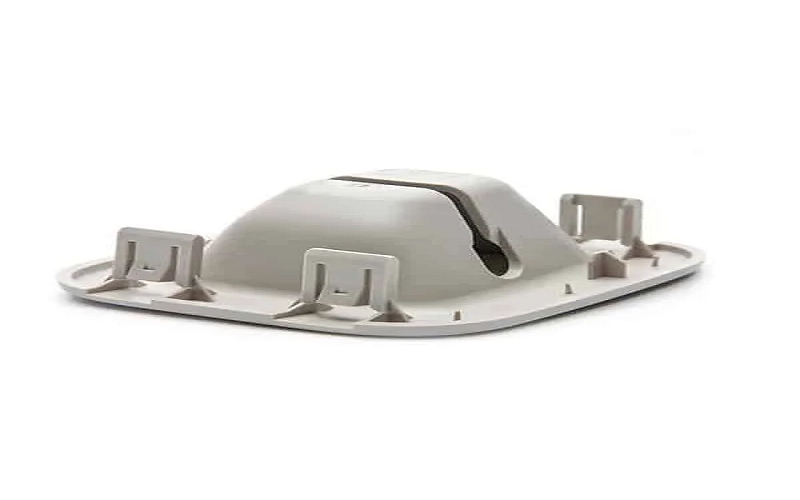
Design guidelines during the TPE injection molding process are crucial to ensuring the quality and performance of the final product.
Material Selection
First, material selection is one of the key factors. The appropriate type of TPE should be chosen based on the specific requirements of the product to meet its mechanical properties, chemical resistance, and high-temperature resistance.
Mechanical Capabilities
During design, the capabilities of the injection molding machine, including injection pressure and mold cavity design, must be considered to ensure the molten TPE material can fill the mold evenly and completely.
Wall Thickness
Second, compared to other materials, TPE has a lower shrinkage rate, so maintaining consistent wall thickness is essential. The wall thickness design should be uniform, avoiding overly thick or thin areas to reduce product deformation and stress concentration.
Cooling Time
Proper cooling time scheduling is also key to ensuring the surface finish and structural stability of the product.TPE injection molding cycle times are typically much faster than thermoset elastomers, allowing you to produce more product faster.
Performance Considerations
Additionally, the design should consider TPE’s elasticity and rubber-like properties to ensure that the finished part can return to its original shape during use, meeting requirements for flexibility and durability.
By following these design guidelines and combining them with strict quality control measures, production efficiency can be effectively improved, waste rate reduced, and ultimately achieve success in TPE injection molding.
Advantages And Disadvantages of TPE In Injection Molding
Thermoplastic elastomers offer a unique combination of rubber-like elasticity and plastic-like processability, making them highly versatile for injection molding applications.
One major advantage of TPE injection molding is the faster cycle times compared to traditional thermoset elastomers, allowing for increased production efficiency and reduced manufacturing costs.
Additionally, TPE materials can be reheated and recycled, significantly minimizing waste and contributing to more sustainable manufacturing practices.
However, TPE also has some disadvantages. Unlike TPU, which offers superior wear and abrasion resistance, some TPE grades may exhibit lower mechanical strength, limiting their use in certain applications that demand high durability.
Precise control of processing parameters such as temperature and injection pressure is essential to avoid defects and ensure consistent quality.
Furthermore, while TPE materials provide excellent flexibility and chemical resistance, they may not perform well under extreme high-temperature conditions compared to some thermoset elastomers.
Overall, the material choice between TPE and other elastomers depends on the specific requirements of the product, balancing factors such as mechanical properties, cost, and environmental considerations.
Applications Of TPE Injection Molded Products
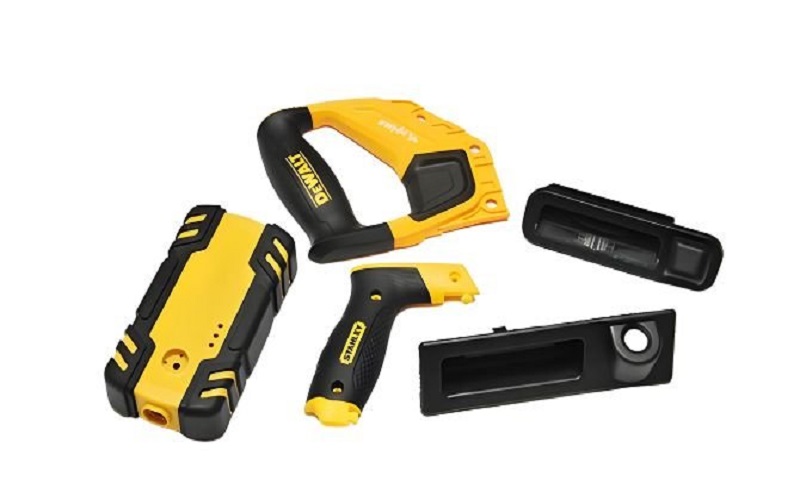
TPE’s applications include soft-touch grips, medical devices, automotive seals, and consumer electronics.
Medical Devices
TPE injection molded products are widely used in catheters, seals, surgical gloves, and medical tubing due to their excellent flexibility and biocompatibility, meeting elasticity and safety standards.
Consumer Products
TPE injection molded products are soft and durable, commonly used in soft-touch handles, sports equipment, phone cases, and toys, providing comfortable grip and wear resistance with a variety of colors and hardness levels, allowing flexible design.
Automotive Industry
TPE is extensively applied in automotive interiors, seals, shock absorbers, and protective covers, offering high temperature and chemical resistance while contributing to lightweight designs that improve fuel efficiency.
Electronics
TPE is used in flexible cable jackets, buttons, seals, and protective covers, providing insulation and wear resistance to protect electronic components and extend their lifespan.
Sports Equipment
TPE is used in shoe soles, protective gear, grips, and elastic bands, offering elasticity and durability suitable for high-intensity sports use.
In summary, TPE injection molded products, with their excellent mechanical properties, environmental friendliness, and flexible design, have become essential materials across multiple industries, driving manufacturing toward high performance and green development.
Conclusion
In conclusion, the TPE injection molding process combines the flexibility and durability of rubber with the ease of processing of plastics, enabling the production of high-quality, flexible, and wear-resistant components.
It is suitable for a wide range of industries, including medical devices, automotive, consumer goods, and electronics, making it an environmentally friendly and cost-effective choice that meets the demands of modern manufacturing.
Success with injection molding of thermoplastic elastomers requires careful planning and attention to detail, including working with experienced professionals.
If you are looking for a reliable injection molding company, FOWMOULD has advanced equipment and extensive experience to provide you with high-quality TPE injection molding solutions.
Whether you have complex design requirements or need large-scale production, we ensure product quality and delivery times to help your project succeed. Please contact us to learn more about our professional services and customized solutions for TPE injection molding.